

Guides
ID tags for elderly loved ones: from engraved bracelets to scan-to-call
The hardest part of caring for an aging parent is the moment they are out in the world without you. Many older adults do not carry a phone, cannot keep one charged, or, with memory loss, may not remember they have one. When a neighbor, a store clerk, or a police officer stops to help, everything depends on one question: can that helper reach the family, right now?
Ships same day, free US shipping. 30-day money-back guarantee.
Why identification matters more after 70
The Alzheimer's Association reports that a majority of people living with dementia will wander at least once, and many do so repeatedly. But wandering is only the sharpest version of an everyday problem. A missed bus, a fall on a walk, a moment of confusion at the pharmacy: in each case a kind stranger is standing next to your parent wanting to help, and the only thing missing is a way to contact you. Paper cards get lost. A phone number sewn into a coat helps only if someone thinks to look. And an older adult may not be able to tell a helper the number themselves.
The options families use
Engraved medical ID bracelets are the standard for a reason, and nothing replaces them for medical facts: conditions, allergies, medications. First responders are trained to look for them. Their limit is the contact path: a tiny engraved phone number that a helper must read, dial, and hope is current, and the bracelet only works if it is worn every day.
Subscription medical ID services add a live phone line behind the bracelet. Stronger, but the helper still has to make a voice call to a call center, relay details, and wait while the service contacts the family.
GPS watches and trackers show you where your loved one is, which is genuinely valuable for wandering. Their weakness is daily reality: they need charging, they need to be worn, and a person with memory loss removes or forgets devices exactly as often as their family fears. They also give the helper on the sidewalk no way to reach you.
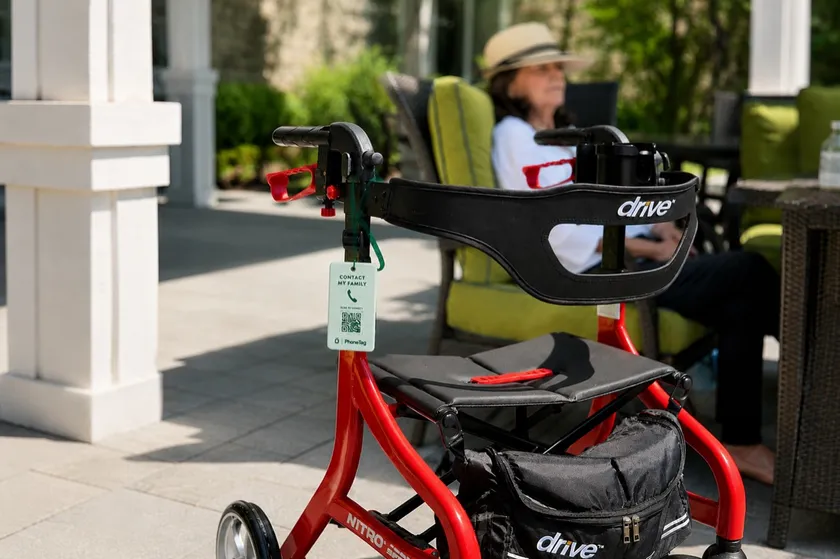
Scan-to-call smart tags attach to the things that always travel with your parent, the walker, the wheelchair, the handbag, the jacket zipper, the cane strap, so there is nothing to remember, wear, or charge. PhoneTag is the version we make: a helper points any phone camera at the tag and a private live video call with your family opens in their browser. No app, no account, any phone. You see your parent, the helper, and where they are. The helper sees a call screen labeled the way you choose, such as "Contact Rose's family," and nothing else.
What the helper experiences
This part matters, because helpers are strangers acting on goodwill. They scan, a call screen opens, and within seconds they are talking to a son or daughter, face to face. They can show you where they are, and the scan shares its location with you automatically. If no one in the family can pick up, the helper can leave a voice or text message that hits every family member's phone at once, or the built-in AI assistant answers, explains that the family has been notified, and can take down details or connect the call live the moment someone is available. Nobody stands on a sidewalk wondering whether their message went anywhere.
Layer it: the bracelet and the tag
These tools are not competitors. The engraved bracelet carries the medical facts for paramedics. The PhoneTag carries the family, live. A complete setup for a parent with memory loss is a worn medical ID, a tag on the walker or wheelchair, one on the everyday bag, and one on the jacket they always reach for. One membership covers up to 12 tags, so the whole setup lives on one account that every adult child can answer.
Be reachable when they need you most
Family Plan: 2 smart tags included, with video calling and the AI assistant. Ships same day, free US shipping. 30-day money-back guarantee.
Order nowCommon questions
What is the best ID tag for an elderly person who wanders?
Layer two tools: an engraved medical ID with critical health information for first responders, and a scan-to-call tag on the things they always have with them, such as a walker, bag, or jacket, so any helper can reach the family instantly.
Does the person helping my parent need an app?
No. A helper points any phone camera at the tag and a private live video call with the family opens in their web browser. Nothing to install, no account to create.
Is a PhoneTag a medical ID?
No. PhoneTag is a family contact tag, not a medical device, and it does not replace an engraved medical ID that lists conditions, allergies, or medications for first responders. Many families use both.
What does the helper see when they scan the tag?
A call screen with a first-name label the family chooses, such as "Contact Rose's family." No phone number, no address, and no medical information is shown, and the family can see where the scan happened.
What if the family cannot answer the call?
The helper can leave a voice or text message that reaches the family's phones immediately, or an optional AI assistant answers, takes a message, and can ring the family and connect the call live.