
Blog
Why you shouldn't put your child's name on their backpack (and what to do instead)
Every August, millions of parents do the same loving thing: they write their kid's name in big friendly letters on the new backpack, the lunchbox, and the water bottle. It feels responsible. It is what our parents did. And safety organizations have spent decades quietly asking us to stop.
Why we label everything in the first place
Let's start by being fair to the label. Parents do not write names on backpacks for fun. Schools ask for it, often in writing, because a classroom of twenty five kids generates a daily blizzard of identical hoodies, matching water bottles, and backpacks from the same three stores. A teacher trying to reunite a jacket with its owner has one practical tool, and that tool is a name.
The lost and found bin is the other half of the story. Anyone who has visited one in June knows the scale of the problem: mountains of unclaimed coats, single gloves, and lunchboxes that sat there all year because nothing on them said who they belonged to. Labeling works. Labeled items go home and unlabeled items get donated. So the instinct to write the name on everything is not wrong. It is solving a real problem. The issue is where the name goes.
The problem with a visible name
Safety organizations, including the National Center for Missing and Exploited Children, have long advised against having a child's name visible on clothing, backpacks, and other belongings. The reasoning is simple and, once you hear it, hard to unhear.
Children are taught to be wary of strangers. But a stranger who calls your child by name does not register as a stranger. "Hey Emma, your mom asked me to pick you up" lands completely differently than the same sentence without the name. The name is a key that unlocks instant, unearned familiarity, and a child has no way of knowing the person simply read it off the backpack ten seconds ago. Kids reasonably assume that someone who knows their name must know their family. That assumption is exactly what a visible name hands to anyone who wants it.
The exposure is not a single moment either. A name in large print on a backpack is broadcast on the walk to school, at the bus stop, in the grocery store, at the airport, and at every playground your family ever visits, every day, for years. You cannot see who reads it.
Two things can be true at once here, and honest safety writing should say both. Stranger abductions are rare, and the overwhelming majority of people who notice a kid's backpack are thinking about nothing at all. This is not a reason to lie awake at night. It is a reason to take a free, effortless precaution: since a hidden label works just as well as a visible one for getting items home, there is no upside to the visible version. When one option carries a known risk and the other costs nothing, you take the other one.
30-day money-back guarantee.
How to label safely
The goal is to keep everything the label does for you while keeping the name away from passing eyes. A few practices cover almost every situation.
Put full names inside, not outside. Write or iron the name onto an interior tag, an inside pocket, or the underside of a flap. Teachers and lost and found volunteers check inside collars and pockets as a matter of routine, so the label still does its classroom job. The kid across the playground cannot read it, and neither can anyone else.
Use initials or a symbol on the outside. If you want an at-a-glance identifier, initials work well inside a classroom, where the teacher already knows every child. Younger kids do even better with a symbol or a color: the dinosaur patch, the yellow ribbon on the zipper. Your child can spot their bag across a cubby wall, and the symbol tells a stranger nothing.
Skip the personalized gear. The same logic applies beyond the backpack. Embroidered names on jackets, printed names on water bottles, name decals on the family car, jerseys with names at the park. Each one is harmless on its own and each one is the same key. When you have the choice, choose the plain version and put the name inside.
Never put a phone number where the world can read it. Some parents swap the name for a phone number, which trades one exposure for another. A number inked on the outside of a lunchbox is public to every person who ever walks past it, and it stays public for the life of the item.
The gap that inside labels leave
There is one honest weakness in the inside-label system: it works beautifully at school and barely at all anywhere else. A teacher will check the inside pocket. The stranger who finds a jacket on a park bench, the bus driver sweeping the last row, the family that spots a lunchbox left at the beach will usually not. Even when they do find a name, a name alone gives them no way to reach you. The item is identified and still lost.
So the modern approach is to split the job in two. The inside label handles the classroom. For everywhere else, you want something on the outside that lets a finder reach you without telling them anything about your family.
The no-name options, ending with the one we make
The simplest version is a tag with a code instead of a name: the finder emails or fills out a form, and a service relays the message to you. That already beats a name, because it identifies the item without identifying the child, though the round trip can take a while and depends on the finder bothering to follow through.
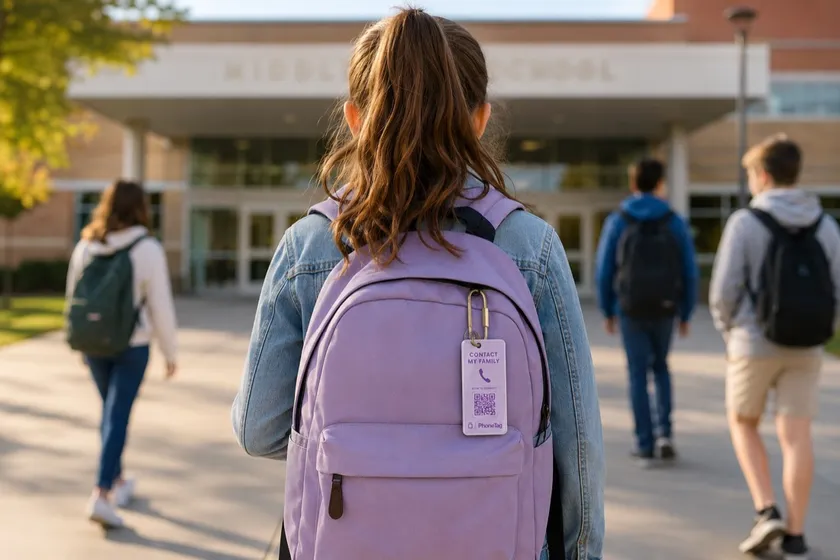
This gap is the reason PhoneTag exists, and it is the reason I built it, so here is the honest pitch. PhoneTag is a small smart tag for the backpack strap or the jacket zipper. Whoever finds the item points their phone camera at it, and a private live video call to you opens right in their browser. There is no app to download and no account to create, and it works from any phone, Android or iPhone. The finder sees a call screen and nothing else: no name, no phone number, no address. You talk for thirty seconds, you say where to leave the bag, and it comes home. If you cannot pick up, the finder can leave a voice or text message, or an optional AI receptionist answers for you and sends you the summary.
From a safety standpoint, it is the inverse of the printed name. The name told every passerby something about your child and gave the one honest finder nothing to act on. The tag tells passersby nothing and gives the honest finder a direct line to you, one that exists only for the moment someone is actually trying to help.
So where should the name go?
Direct answer: on an interior tag, inside pocket, or the underside of a flap, in permanent marker or on an iron-on label. That placement passes every school's labeling requirement, because teachers and lost-and-found volunteers check inside as a matter of routine, and it keeps the name invisible to everyone else. For a full walkthrough of labels, keychain tags, embroidery, and smart tags, see our guide to name tags for school backpacks.
Daycare, camp, and sports bags
The same two-layer rule covers every season. Daycares and camps usually require names on absolutely everything; put them inside, and staff will find them. Sports are the one place names go public by design, on jerseys at the field. That is a community setting with coaches and parents around, which is different from a name broadcast on a solo walk home. The bag itself, though, follows the backpack rule: name inside, identifier outside.
The bottom line
Label everything, because the lost and found bin is real. Keep full names inside, where the people who need them will look. Use initials or a symbol outside if your kid needs a way to spot their own bag. And give the outside of the bag a way to reach you that is not your name and not your number. It is a small change to an old habit, and it removes a risk that never needed to be there.
Identify the bag, not the kid
Family Plan: $59 a year, 2 smart tags included. Video calling and the AI assistant included. Extra tags $12. 30-day money-back guarantee.
Learn moreCommon questions
Is it really unsafe to put my child's name on their backpack?
Safety organizations, including the National Center for Missing and Exploited Children, have long advised against a child's name being visible on clothing and gear. The concern is not the label itself but what it enables: a stranger who greets a child by name no longer sounds like a stranger. The risk of any one incident is low, and the fix is easy, so most experts treat this as a simple precaution worth taking.
My school requires labels. What should I do?
Schools ask for labels so items can be matched to kids, not for the name to be readable across a playground. Put full names inside the item, on an interior tag or pocket, and keep the outside to initials, a symbol, or a scannable tag. Teachers check inside collars and pockets as a matter of routine.
Are initials or a symbol enough to get lost items back?
Within a classroom, usually yes, because the teacher knows the kids. Outside school, initials help very little, which is why pairing an inside name label with a contact method that works anywhere, like a scan to call tag, covers both cases.
How does a scan to call tag identify the item without showing personal information?
The tag carries a unique code instead of a name or number. Whoever finds the item scans the tag with their phone camera and a private call to the parent opens in their browser. The finder never sees the child's name, the family's phone number, or an address, and there is no app or account for the finder.
Where should you put the name on a backpack?
Inside: on an interior tag, an inside pocket, or the underside of the top flap. Teachers check there as a matter of routine, so the label still does its classroom job while staying invisible to strangers. Keep the outside to initials, a symbol, or a scannable tag that shows no personal information.
Should I also remove my child's name from other visible places?
The same logic applies anywhere a stranger can read it at a glance: jerseys with names, personalized water bottles and lunchboxes, car window decals with names, and jackets with embroidered names. Team spirit is fine, but a first name in large print follows your child through every public place they visit.