

Lost and found
Lost and found tags that actually reach you: scan to video call
A lost and found tag has one job: when a stranger picks up your bag, your keys, or your laptop, it has to connect that stranger to you. Most tags do it badly. PhoneTag opens a private live video call to you in the finder's browser, in one scan.
30-day money-back guarantee.
What a lost and found tag is
It is any tag that gives an honest finder a path back to you. That matters more than people expect, because most finders genuinely want to return what they picked up. The item stays lost not because nobody found it, but because the person who found it had no way to reach the owner. The quality of a lost and found tag comes down to how short and how private that path is.
The four generations of lost and found tags
Engraved tags came first: a phone number or address stamped into metal. They work, but they publish your personal number to every stranger who ever glances at your keys, forever, and if your number changes the tag is scrap.
QR profile tags replaced the engraving with a code that opens a web page. Better for privacy, and the contact details can be updated. But the finder lands on a static page, maybe fills out a form, and then waits, holding a stranger's bag, unsure if the message went anywhere. Many give up at that step.
Bluetooth trackers like AirTag solve a different problem, and solve it well. A tracker shows you where the item is on your own map, which is exactly what you want when the bag is under the car seat or left at a specific cafe. What a tracker does not do is let the finder reach you. The person holding your suitcase sees a small piece of plastic with no button to press and no person to talk to.
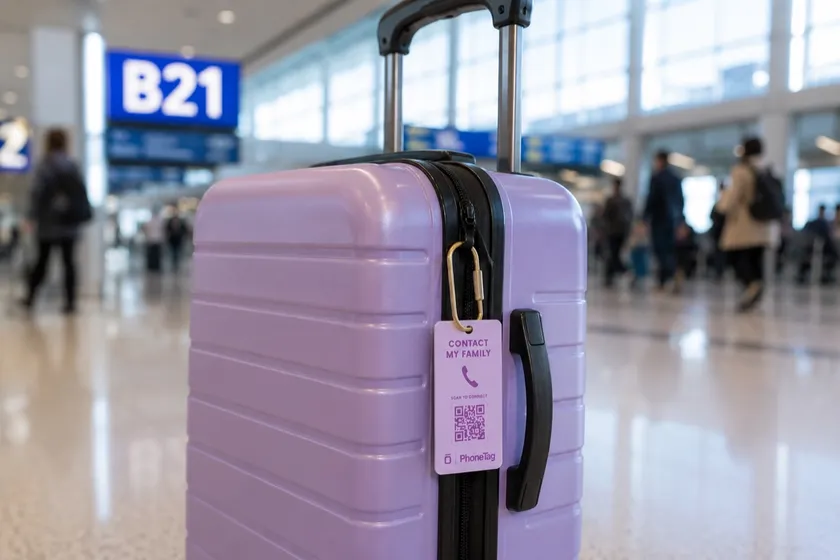
Live-call tags are the current generation, and PhoneTag is one. The finder points their phone camera at the tag and a private video call to you opens right in their browser. No app, no account, no form. Just you and the person holding your stuff, talking.
Why a live call beats a profile page
Returning an item is a conversation, not a form submission. The finder wants to know the item really has an owner who wants it back, and wants to hand off the errand in under a minute. You want to know who has it, where it is, and where to meet. A live video call settles all of that in one exchange, while the finder's goodwill is still standing there with your bag in hand. A profile page asks that goodwill to survive a form, an email relay, and a wait.
Privacy holds through the whole call. The connection is routed through PhoneTag, so the finder never sees your phone number, your name, or your address. If you cannot answer, they can leave a voice or text message that reaches your phone right away, or an optional AI receptionist can answer, ask where the item is, and send you a summary.
Tag the things you would hate to lose
Family Plan: $59 a year, 2 smart tags included. Video calling and the AI assistant included. Extra tags $12. 30-day money-back guarantee.
Learn moreWhat people tag
Luggage, because a checked bag travels farther from you than anything else you own. Backpacks and kids' gear, where the tag also avoids putting a child's name on display. Keys, which are otherwise anonymous by design. Laptops, where a same-day return is the difference between an errand and a disaster. Pets' gear, like collars and harnesses, so the person who finds the dog can show you the dog. One Family Plan covers every tag in the house, and additional tags are $12 each.
Common questions
What is a lost and found tag?
A tag you attach to a bag, keys, laptop, or other item that gives whoever finds it a way to contact you. Older tags engrave a phone number, QR tags open a contact page, and PhoneTag opens a private live video call with you in the finder's browser.
Does the finder need an app to reach me?
No. The finder points their phone camera at the tag and the video call opens in their web browser. There is nothing to download and no account to create.
Is my phone number shown to the finder?
Never. The call is routed through PhoneTag, so the finder sees a call screen and nothing else. No name, no number, no address.
How is this different from an AirTag or other tracker?
A tracker shows you a dot on your own map, which is genuinely useful for locating an item. It gives the finder no way to reach you. PhoneTag connects the person holding your item directly to you, face to face. Many people use both. See our full AirTag for kids comparison.
How much does PhoneTag cost?
The Family Plan is $59 for 12 months or $39 for 6 months, with 2 smart tags included. Extra tags are $12 each, one-time, up to 12 tags and 10 family members on one account. Real-time messaging is free forever, and every order has a 30-day money-back guarantee.