
Guides
ID tags for special needs children and adults
Every safety ID in the world answers the same question: who do I call? For a family caring for a child or adult with a disability, that question has a harder version behind it. Not who do I call, but can this stranger actually reach someone who knows what to do, right now, while they are still standing there. This guide compares the options honestly, including where ours falls short.
Ships same day, free US shipping. 30-day money-back guarantee.
The gap between found and reached
Almost every safety plan for a special needs child or adult is built around being found. Door alarms, GPS watches, shoe trackers, register-with-the-police programs. Those matter, and nothing here replaces them. But there is a second gap that families discover the hard way, usually in a parking lot or a store or a school hallway.
Someone has already found your person. A cashier, a bus driver, a neighbor, a police officer. They are kind, they want to help, and they are stuck. The person in front of them may not speak, may not respond to questions, may be in distress, or may confidently give an answer that is not correct. The helper looks for a phone number and finds one of three things: nothing, a faded number written in a coat, or a bracelet with a number they now have to dial and explain themselves into.
That is the gap. Not location. Contact. And it is the gap that a scan-to-call tag was built for.
Who this guide is for
The details differ, but the contact problem is the same for families supporting:
- An autistic child or adult, especially one who elopes or bolts. See our autism ID tag and elopement guide.
- A non-speaking or minimally verbal person of any age. See our guide for non-verbal children and adults.
- An adult or child with an intellectual or developmental disability, Down syndrome, cerebral palsy, or a genetic syndrome.
- Someone with epilepsy, diabetes, or a condition that can cause sudden confusion in public.
- A parent or grandparent with Alzheimer's or another dementia. See our Alzheimer's and dementia guide and our broader elder care ID tag guide.
- A person who uses an AAC device, a wheelchair, or a walker that may be separated from them.
The options, compared
| Option | What it does well | Where it falls short |
|---|---|---|
| Engraved medical ID bracelet | Carries diagnoses, allergies, and medications. First responders are trained to look for one. Works with no power and no signal. | Must be worn every day, which many people with sensory sensitivities will not tolerate. The contact path is a tiny number a helper has to read and dial. |
| Subscription medical ID service | Adds a staffed phone line and a stored medical record behind the bracelet. | The helper calls a call center, relays details, and waits while the service tries to reach you. You are not in the conversation. |
| Iron-on labels and clothing tags | Cheap, invisible, and survive the wash. Good for identifying belongings. | Only found if someone thinks to look inside a collar. A printed phone number on the outside of clothing is a safety risk, not a safety feature. |
| GPS watches and trackers | Show you a location during a search. Genuinely valuable for a person who elopes or wanders. | Need charging, need to be worn, and are often removed. They give the helper standing next to your person no way to reach you. |
| Wallet cards and communication cards | Explain a diagnosis to a helper or an officer in the person's own words. Excellent for de-escalation. | Can be lost, are easy to miss, and still leave the helper dialing a number cold. |
| Scan-to-call smart tags | Any phone camera opens a live call with the family in seconds. Nothing to wear, charge, or remember. Nothing personal printed on the tag. | Requires the helper's phone to have a data connection, and requires someone in the family to be reachable. Not a medical ID and not a tracker. |
What a helper actually experiences with a PhoneTag
This is the part that decides whether a safety product works in the real world, because helpers are strangers acting on goodwill with about thirty seconds of patience.
They point a phone camera at the tag. A call screen opens in their browser. Within a few seconds they are in a live video call with you, and you can see your person, see the helper, see the street behind them, and see the location the scan came from. You can speak for your child or adult when they cannot speak for themselves. You can explain what helps and what makes things worse. You can ask the helper to stay put while you drive there.
There is no app to install, no account to create, and no number to dial. If nobody in the family picks up, the helper can leave a voice or text message that lands on every family phone at once, or the built-in AI assistant answers, tells them the family has been alerted, takes down where they are, and can ring the family and connect the call live the moment someone is free. Nobody is left standing on a sidewalk wondering if their message went anywhere.
Privacy, which matters more for disability families
Families in this situation are rightly cautious about publishing information, because a diagnosis printed on the outside of a jacket tells a stranger exactly how to take advantage of someone. So the tag itself carries nothing. No name, no number, no address, no diagnosis. A person who scans it sees only the label you chose, such as "Contact my family."
Your phone number is never shared, in either direction. Every scan is logged and shown to you with its location, so you can see who reached out and when. You control every call, and you can block a scanner in one tap. More detail is on our safety page.
Where families put the tags
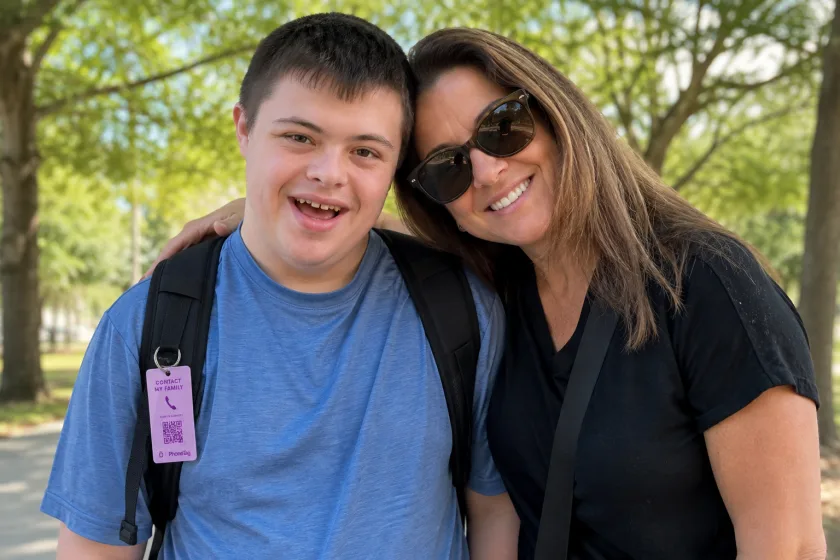
The right answer is the things that never get left behind, and usually more than one of them, because the item you tagged is exactly the item that will be in the other room. Common placements: the backpack or school bag, the wheelchair frame or walker, a belt loop or a shoe, the zipper pull of the jacket they always reach for, the strap of a communication device or AAC case, a lunch bag, and the car seat or stroller. One membership covers up to twelve tags on a single account, so you do not have to choose.
Layer it, do not replace
The strongest setups we see from families are layered, and a scan-to-call tag is one layer of several. Keep the engraved medical ID for paramedics. Keep the tracker if your person elopes. Register with your local police department's special needs or vulnerable person registry if your area has one. Keep the door alarms. Then add tags so that any of the hundreds of ordinary people your person passes each week can reach you instantly rather than calling a number and hoping.
Be reachable in seconds, by anyone, with no app
Family Plan: 2 smart tags included, with video calling and the AI assistant. Ships same day, free US shipping. 30-day money-back guarantee.
Order nowCommon questions
What is the best ID tag for a special needs child?
Layer two things. An engraved medical ID carries diagnoses, allergies, and medications for first responders. A scan-to-call tag on the items your child always has with them lets any helper reach you live in seconds, with no reading, dialing, or explaining.
Does the person who finds my child need to download an app?
No. They point any phone camera at the tag and a private live video call with your family opens in their browser. Nothing to install, no account to create.
Is a PhoneTag a medical ID or a GPS tracker?
Neither. It is a contact tag. It does not replace an engraved medical ID for paramedics, and it does not report a location on its own. It works when someone scans it, and it shares the location of that scan with you.
What personal information is printed on the tag?
None. No name, no phone number, no address, and no diagnosis. A helper sees only a call screen with the label you chose, such as "Contact my family."
What happens if no one in the family can answer?
The helper can leave a voice or text message that reaches every family phone at once, or an AI assistant answers, takes down details, and can ring the family and connect the call live when someone is available.
Can more than one caregiver answer the call?
Yes. Add up to nine additional people to one account so both parents, a grandparent, a sibling, or a paid caregiver all ring at once and whoever is free picks up.
Will it work if my child cannot or will not wear anything?
That is the usual reason families come to a tag instead of a bracelet. Nothing has to be worn. Tags attach to the bag, the wheelchair, the walker, the belt loop, the shoe, or the jacket zipper, so there is nothing on the body to tolerate, remove, or charge.