
Blog
A tag that speaks for Cookie
We usually write about kids and backpacks. This one is about the other end of the family, the parents and grandparents who move into assisted living, and a small tag that helps them stay a single scan away from the people who love them. It starts with Cookie.
Meet Cookie
Cookie is a resident at The Bristal, an assisted living community in New York. By every account she is the social heart of her floor, the one who remembers everyone's grandchildren and saves you a seat at dinner. What she does not always remember, on a hard afternoon, is her daughter's phone number. Most of us have not dialed a number from memory in fifteen years, and for someone in their eighties, on a day when the words come slower, that small gap can turn an ordinary moment into a scary one.
The old answer was a card in the wallet or a name sewn into a coat: a parent's phone number written where a helpful stranger might find it. It works, sort of, the same way it works for a child. But it asks the finder to make a cold phone call to a number they do not recognize, and it hands that number to anyone who looks. Cookie deserved something better, and so does everyone on her floor.
30-day money-back guarantee.
What a scan to call tag does in a care setting
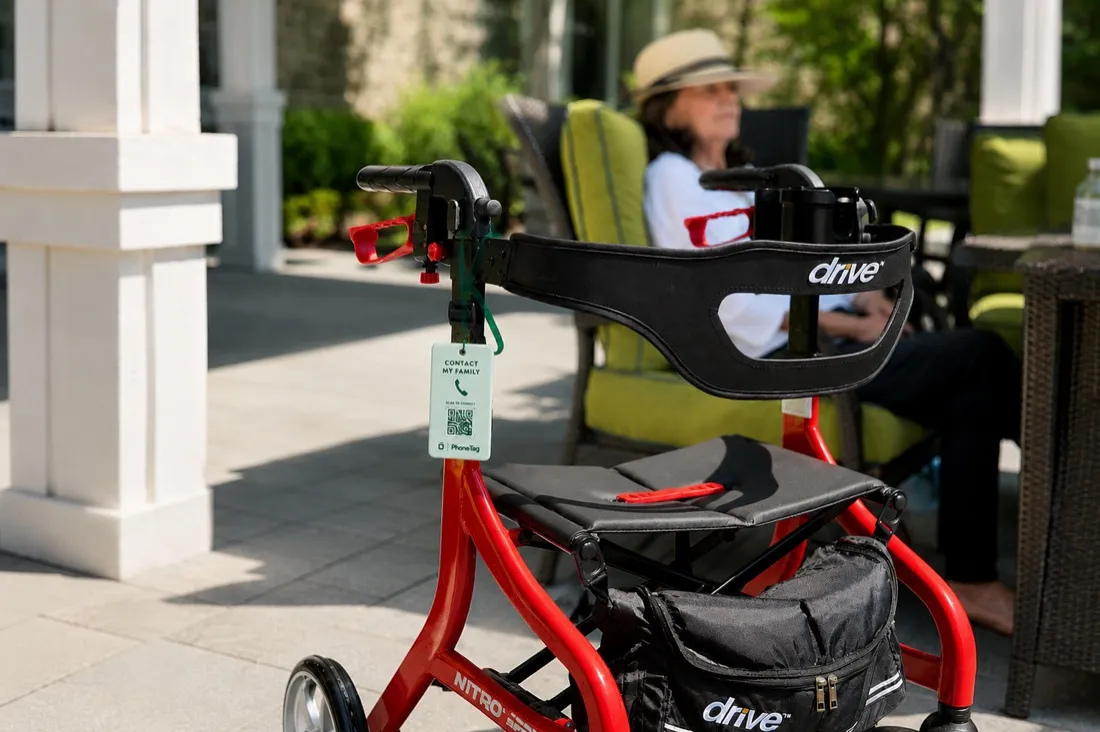
PhoneTag is a small tag with no battery and no app. It does nothing until a person picks it up and scans it with a phone camera, and then it does one thing very well: it opens a private live video call to the family. For Cookie, that tag rides on the lanyard she already wears. When she is in the lobby and cannot quite place how to reach her daughter, any aide, nurse, neighbor, or visitor can point a phone at the tag and, in seconds, her daughter is on the screen, seeing her mother's face and the room she is standing in.
Three things about that moment matter more in later life than anywhere else.
It is a face, not a form. A video call does something a phone number never could. The family can see that Cookie is calm, that she is with a kind staff member, that she is in the dining room and not lost outside. Reassurance travels through a face in a way it cannot travel through a voicemail.
Anyone can use it, with nothing to install. The person helping in a care setting is rarely the family. It is an aide mid shift, a physical therapist, a bus driver on the memory care outing, sometimes a stranger who noticed a resident a block from the building. None of them should have to download anything. They point their own phone and the call just opens.
It protects the family, and the resident's dignity. The finder never sees a phone number, a last name, or a home address. And Cookie is not wearing a sign that announces she has memory trouble. She is wearing a small, ordinary tag, and she stays the capable, social woman her floor knows, with a quiet safety net that only appears when it is needed.
When no one can pick up
Families are at work, on planes, asleep. A safety net that only works when a specific person answers is not much of a net. When the family cannot take the call, the PhoneTag AI assistant answers in a natural voice, talks with whoever scanned the tag, notes where the resident is and what they need, and sends that to the family right away. A staff member who scanned in a hurry is never left talking to a dead line, and the family comes back to a clear message instead of a missed call.
A note on wandering
The hardest fear in memory care is a resident who leaves and cannot find the way back. It is worth being precise about what a contact tag does and does not do here. PhoneTag is not a GPS tracker. It will not draw a moving dot on a map. What it does is make sure that the moment a person finds a resident, on the wrong bus, at a diner counter, two streets over, that person can reach the family instantly and face to face, without knowing the family or the resident. Many families pair it with a location device for exactly this reason: the tracker helps you find the person, and the tag lets whoever finds them first bring them home. They solve two different halves of the same worry.
Not only for the hard days
It would be a shame to frame this only around crisis. Most of what Cookie's tag does is ordinary and warm. A grandchild visiting for the first time in months scans it and instantly video calls the rest of the family into the room. An aide who adores her uses it to loop in her daughter about a good day. The same little tag that quietly covers the frightening moments spends most of its life simply making it easier for a family to be present with someone they cannot see every day. That is the part we did not expect, and the part we love most.
A quiet safety net for someone you love
Family Plan: $59 a year, 2 smart tags included. Video calling and the AI assistant included. Extra tags $9. 30-day money-back guarantee.
Learn moreCommon questions
Is PhoneTag a GPS tracker for a resident who wanders?
No. PhoneTag has no radio and no battery, so it does not report location on its own. It works the moment a person scans it, which is exactly when a staff member, neighbor, or passerby has found the resident and wants to reach the family. For families who also want live location, a separate tracker can be worn alongside it.
Does the person who scans it need an app?
No. They point a phone camera at the tag and a live video call to the family opens in the browser, with no app and no account. That matters in a care setting, where the person helping could be an aide, a nurse, a driver, or a stranger on the sidewalk.
What if the family cannot answer the call?
The PhoneTag AI assistant answers in a natural voice, speaks with whoever scanned the tag, gathers the details, and sends them to the family right away. A moment when no one picks up does not become a dead end.
Where does a resident wear or carry the tag?
Common spots are a lanyard, the front pocket of a walker or wheelchair bag, a purse or wallet, a keyring, or clipped inside a favorite jacket. The goal is somewhere a helping hand would naturally look.
Is the family's phone number exposed to whoever scans it?
No. The call is routed through PhoneTag, so the family's phone number, name, and home address are never shown to the person who scanned the tag.