

Guides
Alzheimer's ID tags: reaching the family when a parent is lost
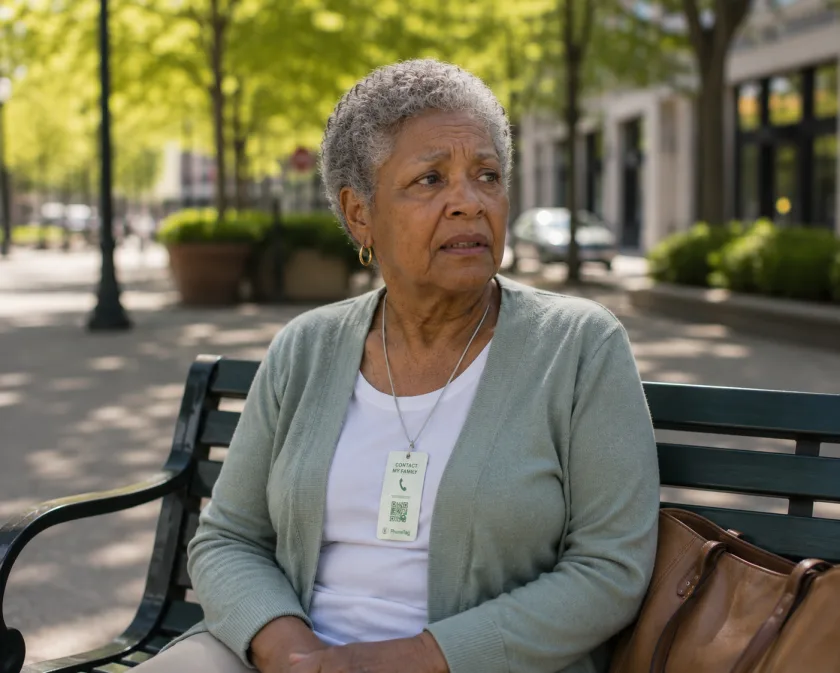
Most families who care for a parent with Alzheimer's build their whole safety plan around finding them. Door alarms, trackers, a list of the places she might walk to. What almost nobody plans for is the far more likely version: a stranger has already found her, is standing next to her being kind, and cannot work out who to call.
Ships same day, free US shipping. 30-day money-back guarantee.
How common wandering is
The Alzheimer's Association reports that six in ten people living with dementia will wander at least once, and many do so repeatedly. It can happen at any stage, including early on, when a person is still driving, still shopping, and still living at home. The 2026 Alzheimer's Disease Facts and Figures report counts an estimated 7.4 million Americans age 65 and older living with Alzheimer's dementia, cared for largely by unpaid family members who provided more than 19 billion hours of care in a single year.
Wandering rarely looks dramatic from the outside. It looks like getting off at the wrong stop, walking home from a store by a route that no longer exists, or leaving a doctor's waiting room while a daughter parks the car. The Alzheimer's Association is direct that the risk climbs steeply the longer a person is not found, which is why the first hour matters more than any other.
What the helper is up against
Put yourself in the shoes of a pharmacist, a bus driver, or a police officer who has just realized the person in front of them is confused and alone. They ask her name and get an answer from forty years ago. They ask for a phone number and get a number that was disconnected in 2009. They look for a bracelet.
If they find an engraved number, they now have to dial it and hope a daughter picks up a call from an unfamiliar number, then describe a woman and a street corner well enough for the family to find her. If they find nothing, the only remaining path is a police station or an emergency room, and a frightened person with memory loss ends up in the worst possible environment for her.
The options families use
| Option | Good for | The catch |
|---|---|---|
| Engraved medical ID bracelet | Diagnoses, medications, and allergies for paramedics. First responders are trained to look. | Has to be worn daily, and a person with memory loss often removes jewelry. Contact is a number the helper must read and dial. |
| Subscription medical ID service | A staffed 24 hour line and a stored medical record behind the bracelet. | The helper reaches a call center, not you. Details get relayed twice and time passes while the service tries to find a family member. |
| GPS trackers and smart watches | Searching in the window before someone finds her. Real value if she leaves the house alone. | Charging, wearing, and removal. Gives the person standing next to her no way to contact you. |
| Project Lifesaver and police registries | Trained local response and a radio locator in many counties. Often free or low cost. Worth enrolling. | Only engages once law enforcement is involved, which is usually not the first thirty minutes. |
| Scan-to-call tags | The moment she has been found. Any helper with any phone reaches your family live and sees where they are. | Needs a data connection on the helper's phone and someone reachable on your side. Not a tracker, not a medical ID. |
What happens when someone scans a PhoneTag
The helper points a phone camera at the tag. A call screen opens in their browser, and in a few seconds your family is in a live video call. You see your mother's face and can judge in one glance whether she is calm or frightened. You see the helper. You see the storefront behind them, and the scan location is shared with you automatically with one-tap directions in Apple Maps, Google Maps, or Waze.
Then you can do the thing no bracelet allows: talk to her. Hearing a daughter's voice settles a confused person faster than any stranger's reassurance. And you can tell the helper what actually helps. That she responds to her maiden name. That she will follow someone who offers her a chair. That she should not be put in a car. That you are twelve minutes away and please just stay with her.
Everyone on the account rings at once, up to ten people, so siblings and a paid caregiver all get the call and whoever is closest answers. If nobody can pick up, the helper leaves a voice or text message that lands on every phone at once, or the AI assistant answers, confirms the family has been alerted, notes where they are, and can ring the family and connect the call live the moment someone is free. Nobody is left holding a phone that just rang out.
Where to put the tags
The rule is the objects that go where she goes, and more than one of them. Families most often tag the walker or rollator, the wheelchair frame, the everyday handbag, the cane strap, the keyring, the jacket she always reaches for, and a lanyard if she will wear one. In assisted living, tags also go on the bag she carries to the dining room and to appointments. One membership covers up to twelve tags, so covering all of it costs less than replacing a single lost afternoon.
Layer it, and keep the bracelet
These tools do not compete. The engraved medical ID carries the medical facts for paramedics and works with no battery and no signal. The tracker helps you search. The police registry brings trained responders. The tag closes the last gap, which is also the most common one: an ordinary person has found her and needs to reach you now. Keep all of them.
For the wider set of elder care questions, including options for a parent who does not have dementia but no longer carries a phone, see our guide to ID tags for elderly loved ones, and our note on staying reachable in assisted living.
What this is not
PhoneTag is a contact tag. It is not a medical device, it does not replace an engraved medical ID, and it is not a GPS tracker, so it tells you nothing until someone scans it. It cannot prevent wandering. It shortens the distance between the moment your parent is found and the moment your family is on the line, and that is the whole claim.
Be one scan away, day or night
Family Plan: 2 smart tags included, with video calling and the AI assistant. Ships same day, free US shipping. 30-day money-back guarantee.
Order nowCommon questions
How common is wandering with Alzheimer's?
The Alzheimer's Association reports that six in ten people living with dementia will wander at least once, and many do so repeatedly. It can happen at any stage, including early on.
What is the best ID for someone with Alzheimer's who wanders?
Layer three things: an engraved medical ID for paramedics, enrollment in a local return program or police vulnerable person registry, and a scan-to-call tag on the walker, handbag, and jacket so any helper can reach the family live.
Why not put my phone number on my mother's bracelet?
You can, and it is better than nothing. The limit is what it asks of a stranger: find the engraving, read it, dial a number you may not answer, and explain everything cold. A scan opens a live video call instead, so you can see her and speak to her yourself.
Is a PhoneTag a GPS tracker for dementia?
No. It does not report a location on its own and will not help you search for someone who has not been found. It solves the other half: the moment she has been found and the helper needs your family. Many families use both.
Does my mother have to wear or charge anything?
No. Tags attach to the walker, wheelchair, handbag, cane, keyring, or jacket zipper. There is no battery, nothing to charge, and nothing on the body to remove or refuse.
Can all of my siblings answer the call?
Yes. One account rings up to ten people at once, so siblings, a spouse, and a paid caregiver all get the call and whoever is free picks up.
Will it work in a memory care community?
Yes, and staff scanning a tag is a common use. It gives an aide an instant line to the family for a question that would otherwise wait for a callback, and it means a resident who leaves the building with her handbag carries a way home in it.