

The tag that video-calls you
A tracker shows a dot. PhoneTag lets whoever is with your child call you.
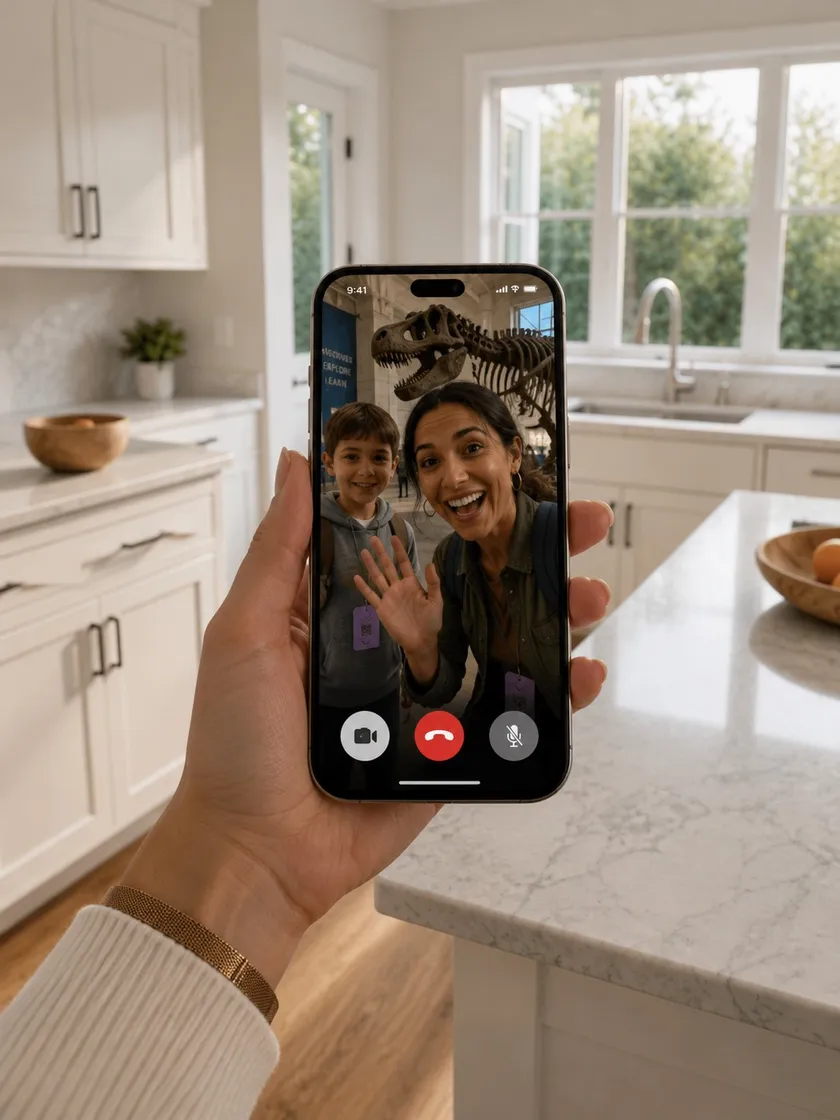
Just clip a PhoneTag to their backpack, jacket, lunch bag, or just about any item. One scan of the QR code is all it takes to share their location and start a real time chat or live video call with you. No app for them, your number's never shared, and there's no battery required.
- Works from school iPads and Chromebooks: no phone needed to call you
- Free US shipping, ships same day
- 30-day money-back guarantee
- Cancel anytime
Guides
Kids tracker alternatives: what a dot on a map can't do alone
Every kids tracker answers one question: where is my child? It is a fair question, and for some families a GPS device is the right tool. But there is a second question the map never answers: the teacher, the coach, the parent at the playground, the stranger who just found your child's backpack, how do they reach you, right now, without your phone number? Here is every option honestly compared, including the one we make.
First, be clear about the two different problems
Problem one: you don't know where your child is. That is what GPS trackers, phone watches, and AirTags are for. They plot a dot.
Problem two: the person WITH your child can't reach you. A tracker does nothing here. Your child is standing next to an adult who wants to help, and that adult's options are calling the police or waiting. No dot on your map fixes that, and this is the moment most lost-kid stories actually hinge on.
PhoneTag is built for problem two, which is why we tell parents plainly: it is not a tracker, and if you need continuous location, buy one. Many of our families run both.
Option
1Dedicated kids GPS trackers
Purpose-built devices with a SIM card and a family app. Continuous location, geofence alerts, some with two-way voice.
live location anywhere with cell coverage, wander alerts, kids who can't carry a phone.
hardware typically $100-200 plus a $10-50 monthly cellular plan, daily charging, and a device your child must actually wear and keep charged. And the finder standing next to your child still has no way to call you.
Option
2AirTags and Bluetooth finders
Cheap, tiny, no subscription, and genuinely good at finding a bag in a dense area through the Find My network.
locating the backpack itself, especially in cities.
Apple says AirTags are designed for things, not people, and the anti-stalking system can announce a moving AirTag to nearby iPhones. Location updates only when an Apple device passes by. And again: no way for anyone to contact you.
Option
3Phone watches
A watch with a SIM. Location plus actual calling, for kids old enough to use one.
older kids, direct two-way contact with your child.
$150-300 plus a monthly plan, daily charging, school rules that often ban them, and it only helps if your child can and may use it. A helper still can't reach you through it.
Option
4PhoneTag tags and the Smart Band
PhoneTag is a small weatherproof tag for the backpack strap, jacket zipper, or lunchbox. No battery, no charging, nothing to break. Whoever is with your child points any phone camera at it and chooses to send a message or start a private audio or video call to your phone from theirs. No app for them to download, no account, just a scan, and they never see your name or number, just a call screen that you control.
You see who is calling and where the scan happened, because the scanner's phone shares its location for that call. If you can't pick up, the whole family can be set to ring, the caller can leave a message, or the built-in AI assistant answers with the instructions you set and sends you the summary.
For the kid who won't keep a tag on a bag, there is the Smart Band: a soft silicone wrist band with a PhoneTag on top and a pocket underneath for an Apple AirTag (sold separately). The AirTag gives you the Find My map, the PhoneTag gives whoever is with your child a way to reach you, and because it is worn, both stay with your child rather than the backpack.
the moment someone is WITH your child and needs you: one scan starts a message or a private audio or video call, with no app for them and your number never shown. The tag needs no battery; the Smart Band adds the map when you put an AirTag in it.
the tag on its own is a communication platform, not a tracker, and shares location only when it is scanned. For a live map, use the Smart Band with an AirTag, or pair a tag with any tracker. Apple designs AirTag for items, and its anti-stalking alerts apply on a wrist just as in a bag.
Phone-banned school?
Works from devices that can't dial.
School iPads and Chromebooks. A Wi-Fi-only hand-me-down phone. A tablet at a friend's house. None of them can place a phone call. All of them can open a camera and a browser, and that is all PhoneTag needs.
In a phone-banned school, these are the devices your kid actually has. Your child scans the tag on their own backpack with the classroom iPad and your phone rings. A teacher or nurse can do the same from theirs. No phone number, no app, no cellular plan on their end.
a school iPad or Chromebook, a Wi-Fi-only phone, a tablet at a friend's house, any phone with a camera.
a camera to scan the tag and a browser to open the call, on Wi-Fi or cellular. That is it.
2 smart tags included. Ships same day, free US shipping. 30-day money-back guarantee.
Permission slip mix-up on day three meant my daughter missed her friend’s bus and her own. The attendant scanned her PhoneTag, I answered right away, my sister picked her up fifteen minutes later. One scan, problem solved. Thank you!
Today we received the product you brilliantly created and we love it! Thank you so much!
 Deb Thivierge, BCaBA, NYS-CBAA · The ELIJA School CEO/Founder
Side by side
Read across: only the last column answers both where your child is and how the person with them reaches you.
| Feature | GPS tracker | AirTag alone | Phone watch | PhoneTag tag | Smart Band + AirTag |
|---|---|---|---|---|---|
| Shows where they are on a map | ✓Live GPS | ✓Find My, approximate | ✓Live GPS | Location at each scan | ✓Find My, plus each scan |
| The person with them can reach you | – | – | –Only the wearer calls | ✓One scan: video, audio or text | ✓One scan: video, audio or text |
| AI answers when you can’t | – | – | – | ✓ | ✓ |
| Your number stays private | ✓ | ✓ | ✓ | ✓Never shown | ✓Never shown |
| Stays on your child | If clipped on | In a bag | ✓Worn | On the bag | ✓Worn on the wrist |
| Charging | Daily | Battery yearly | Daily | ✓Never | AirTag battery yearly |
| Typical cost | $100-200 + $40-60/mo | $29, no plan | $150-300 + cellular plan | One plan, 2 tags included | $19 band + your AirTag |
The AirTag is sold separately and works with Find My on iPhone.
The pairing that covers both problems
A map answers where. A PhoneTag answers how the person standing next to your child reaches you. They are not rivals; they are two halves of the same peace of mind, and you can have both two ways: an AirTag or GPS device in the bag with a PhoneTag on the strap, or both in one piece on the wrist with the Smart Band, an AirTag tucked under the PhoneTag so the map and the call go wherever your child goes.
Put a PhoneTag on what you love.
The Family Plan covers every tag on the account: 2 smart tags included, video calling, the AI assistant, messaging, and scan location.
Learn moreShips same day, free US shipping. 30-day money-back guarantee. Cancel anytime.
Common questions
Is PhoneTag a GPS tracker for kids?
No. It has no GPS chip, no battery, and no continuous location feed. It is a contact tag: one scan opens a private live video call to you. You see where each scan happened, and nothing is tracked between scans.
What is the best alternative to a GPS tracker for kids?
Match the tool to the problem. Continuous location: a GPS device or phone watch. Letting the person with your child reach you instantly, with no app and no exposed number: a contact tag. Many families run both.
Do AirTags work for tracking kids?
They locate bags well in dense areas, but Apple says they are designed for things, not people, and anti-stalking alerts can announce them. They also give a finder no way to contact you. The PhoneTag Smart Band holds an AirTag under a PhoneTag, so the same band gives you the map and gives whoever is with your child a way to call you. Our full AirTag-for-kids breakdown is here.
Does it work from a school iPad, Chromebook, or a phone with no service?
Yes. Any device with a camera and a browser can scan the tag and start the call, on Wi-Fi or cellular, with no phone number and no app. That covers school iPads and Chromebooks, a Wi-Fi-only hand-me-down phone, and a tablet at a friend's house. In a phone-banned school your child can reach you from the classroom device by scanning their own tag.
Does the person who scans a PhoneTag need an app?
No. Any phone camera opens the call straight in the browser, and the scanner never sees your name, number, or address.
AirTag, Find My and iPhone are trademarks of Apple Inc., registered in the U.S. and other countries. Apple Inc. is not affiliated with, and does not sponsor or endorse, PhoneTag. The Smart Band is a PhoneTag accessory that holds an AirTag; the AirTag is sold separately.