

Guides
Autism ID tags and wandering: what actually helps when your child bolts
Most parents of an autistic child who bolts will tell you the same thing. The worst part is not the searching. It is not knowing whether the person who finds their child will be able to reach them. This guide is about closing that gap, and it is honest about what an ID tag can and cannot do.
A note on the word "elopement." If you are new to an autism diagnosis, you will start seeing this term everywhere: in school IEPs, in safety plans, in research. It has nothing to do with running off to get married. In this context elopement means wandering or bolting away from a safe place, a caregiver, or a supervised setting. Doctors, schools, and researchers use it; most parents just say wandering or bolting. This page uses all three, because they mean the same thing.
Ships same day, free US shipping. 30-day money-back guarantee.
How common elopement really is
The number most families are quoting comes from a 2012 study of 1,218 families published in Pediatrics by Anderson and colleagues, run through the Interactive Autism Network at the Kennedy Krieger Institute. It found that 49 percent of children with autism had attempted to elope at least once after age 4, roughly four times the rate of their non-autistic siblings. Attempts peaked around age five. Of the children who went missing, 53 percent were gone long enough to cause serious concern, 65 percent had a close call with traffic, and 24 percent were in danger of drowning. And 62 percent of parents said the risk had stopped them from attending activities outside the home.
That last number is the one families feel every weekend. Elopement does not only endanger a child. It shrinks a whole family's life.
Why most elopements end with a stranger, not a search
Search and rescue gets the attention, and rightly so, because water is the leading danger. But the far more common ending is quieter and happens in minutes: a child is standing in a parking lot, a store aisle, a train platform, or a neighbor's yard, and an ordinary adult has stopped to help.
That adult is now trying to solve a problem they are badly equipped for. They ask the child their name and get no answer, or an answer they cannot use. They look for a bracelet. They check a backpack for a label. Meanwhile the clock is running, and the single most useful thing in the world at that moment is a fast, unambiguous way to reach a parent.
This is where a printed phone number underperforms. It works, but slowly and awkwardly: the helper has to find it, read it correctly, dial it, get past your assumption that an unknown number is spam, and then explain who they are and where they are to a parent who has just gone into fight or flight. Every one of those steps is a place the connection breaks.
What makes autism ID different from ordinary child ID
- Wearables often lose. Bracelets, necklaces, and watches are sensory objects. A child who cannot tolerate a seam in a sock is not going to tolerate a silicone band all day, and a child who can remove it usually will. An ID your child takes off in the car is not an ID.
- Your child may not respond to their name. Plenty of safety advice quietly assumes the child will answer questions or ask for help. Build the plan so it works when they do not, and any version that depends on your child speaking is a plan with a hole in it.
- Speaking for your child matters. A helper who is told over the phone to "keep him there" may grab a wrist, and that can turn a calm situation into a meltdown or a bolt into traffic. Being able to see the scene and say "please do not touch him, just stay a few feet away and talk about trains, I am four minutes out" is a different category of help.
- Nothing printed on the outside. A tag reading "AUTISTIC, NON-VERBAL, CALL MOM 516-555-0134" tells a stranger exactly how to exploit a vulnerable child. Keep diagnoses for the medical ID and first responders, not for the sidewalk.
The options, honestly
| Option | Good for | The catch |
|---|---|---|
| Engraved ID bracelet | Medical facts for paramedics. No battery, no signal needed. | Has to be worn and tolerated. Contact is a small number the helper must read and dial. |
| GPS watch or tracker | Searching for a child who is actually missing. Real value in a water-adjacent area. | Charging, wearing, and removal. Gives the helper standing next to your child nothing. |
| Temporary tattoos and iron-on labels | Cheap, no sensory footprint, good for outings and events. | Wear off, wash out, and put a phone number in public view. Easy to miss. |
| Police or first responder registry | Officers arrive already knowing your child's needs. Free in many towns. Do this one. | Only helps once law enforcement is involved, which is often not the first ten minutes. |
| Scan-to-call tag | The first ten minutes. Any helper with any phone reaches you live, and you can guide them. | Needs a data connection on the helper's phone and someone reachable on your side. Not a tracker, not a medical ID. |
How PhoneTag works for an autistic child
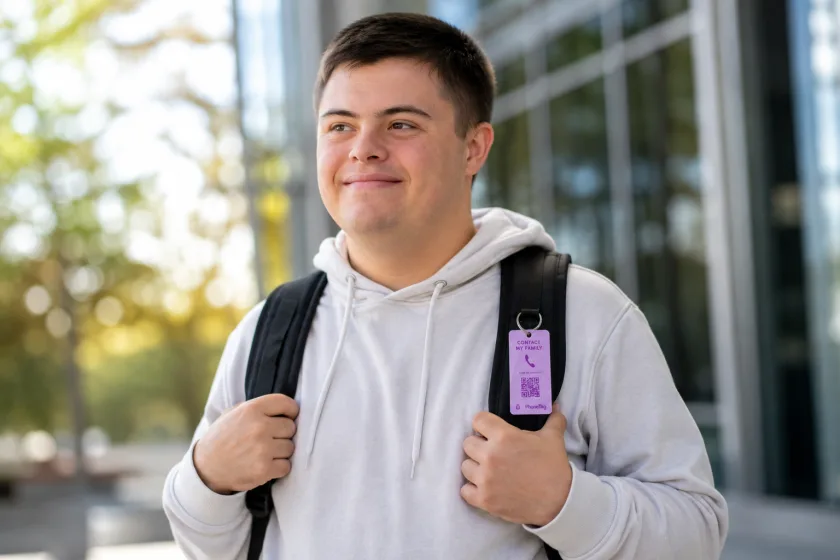
The tag clips to the gear rather than the child: the backpack, a belt loop, a shoe, the zipper pull of the jacket they always wear, a wheelchair frame, or the strap of a communication device. There is nothing on the body to tolerate, nothing to charge, and nothing to remember.
When someone finds your child, they point a phone camera at the tag. A call screen opens in their browser, and within seconds you are in a live video call. You see your child. You see the helper. You see the street sign behind them, and the scan's location is shared with you automatically, with directions in Apple Maps, Google Maps, or Waze in one tap. You can talk to your child in your own voice, which for many kids is the fastest thing in the world at bringing the temperature down. And you can tell the helper exactly what to do and what not to do.
Everyone you add to the account rings at once, up to ten people, so a second parent, a grandparent, a sibling, or an aide can pick up if you are in a meeting. If nobody can answer, the helper leaves a voice or text message that hits every phone at once, or the AI assistant answers, tells them the family has been alerted, takes down where they are, and can ring the family and connect the call live the moment someone is free.
What it is not
It is worth being direct, because families in this situation are sold a lot of things. PhoneTag is not a GPS tracker and will not tell you where your child is when nobody has scanned the tag. It is not a medical device and does not replace an engraved medical ID listing seizure disorders, allergies, or medications. It does not prevent elopement, and no product does. It closes one specific gap: the minutes between a stranger finding your child and that stranger reaching you.
A layered plan that works
- Locks and door or window alarms at home, and a written elopement plan the whole household knows.
- Register with your local police department's special needs or vulnerable person registry, and with Project Lifesaver or a similar program if your area runs one.
- An engraved medical ID if your child will wear one, carrying the medical facts only.
- A tracker if your child elopes toward water or roads, accepting that it needs charging and wearing.
- Scan-to-call tags on every bag, jacket, and wheelchair, so that any of the hundreds of ordinary people your child passes each week can reach you in seconds.
- A short, calm script you can say to a helper on the call. Write it now, not in the moment.
Make sure whoever finds your child can reach you
Family Plan: 2 smart tags included, with video calling and the AI assistant. Ships same day, free US shipping. 30-day money-back guarantee.
Order nowCommon questions
What does elopement mean in autism?
It means wandering or bolting away from a safe place, a caregiver, or a supervised setting such as a classroom or a yard. It has nothing to do with the everyday meaning of running off to get married. Schools, clinicians, and researchers say elopement; most parents say wandering or bolting. Same behavior, different vocabulary.
How common is elopement in autistic children?
In a 2012 Pediatrics study of 1,218 families, 49 percent of children with autism had attempted to elope at least once after age 4, about four times the rate of their siblings. Among those who went missing, 65 percent had a close call with traffic and 24 percent were in danger of drowning.
What is the best ID for an autistic child who will not wear a bracelet?
Put the ID on the gear, not the body. A scan-to-call tag clips to a backpack, belt loop, shoe, jacket zipper, or wheelchair, so there is nothing on the skin to tolerate and nothing to take off.
Is an autism ID tag the same as a GPS tracker?
No. A tracker helps you search for a missing child. A scan-to-call tag helps the person who has already found your child reach you. Most elopements end with a stranger next to the child, so many families use both.
What does the person who finds my child see?
A call screen with the label you chose, such as "Contact my family." No name, no phone number, no address, and no diagnosis. One tap opens a private live video call in their browser with no app.
Can I tell the helper how to interact with my child?
Yes, and it is the main reason to prefer a live call over a printed number. You can see the scene, speak to your child, and tell the helper what calms them and what to avoid.
What if I cannot answer?
Up to ten people on one account ring at once. If nobody is free, the helper can leave a voice or text message that reaches every phone, or an AI assistant answers, takes the details, and can ring the family and connect the call live.
Is the tag waterproof and durable?
Yes. The tags are made to live outdoors on a backpack through a school year, and they have no battery, so there is nothing to charge or replace.