

Compare
AirTag in your kid's backpack? What it can and can't do (and what to add)
Dropping an AirTag into the backpack is one of the most common back to school moves there is, and for good reason. It genuinely helps. It also has real limits that most parents only discover after the first lost jacket or the first email from a confused teacher. Here is the honest picture.

Short answer: an AirTag tells you where the backpack is, but it gives the person who finds it no private way to reach you. Add a PhoneTag ($11) so anyone can scan it and contact you without seeing your number, or use the Smart Band ($11) to put your AirTag and a PhoneTag together on your child's wrist.
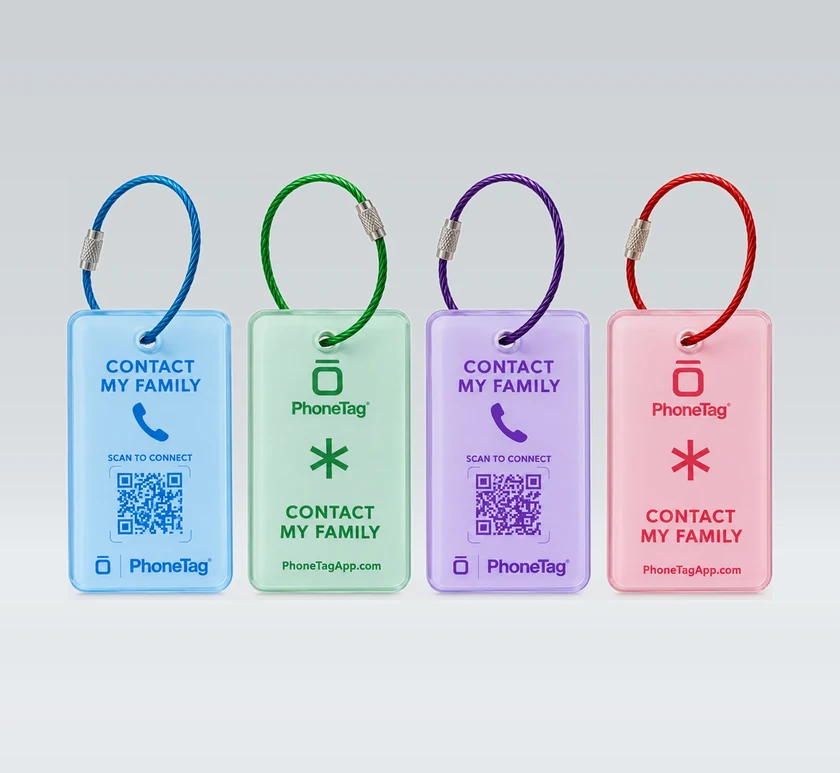
PhoneTag
$11 or any two for $19
Clips to the backpack, jacket or lunchbox. Whoever finds it scans it and reaches you. No battery, no beeping, four colors.
Shop PhoneTags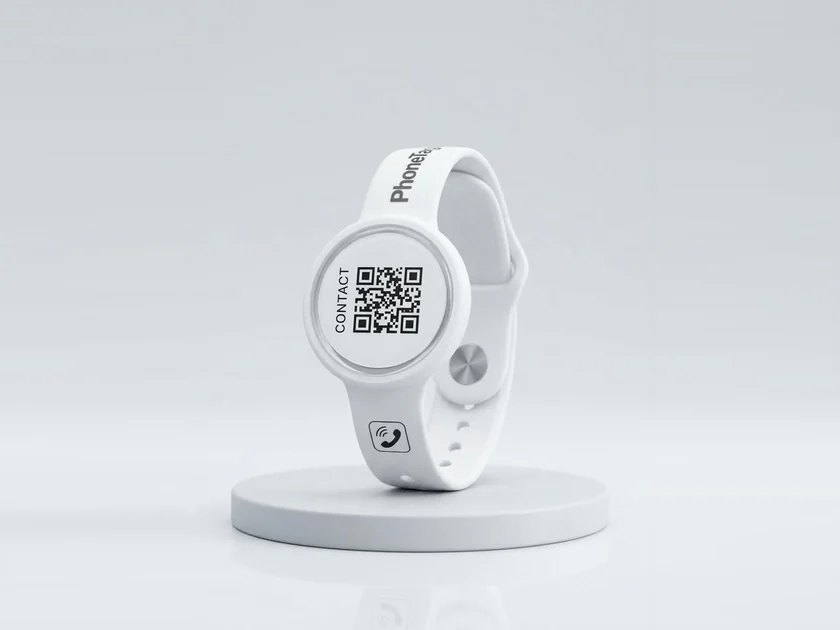
Smart Band
$11 or any two for $19
A soft wristband that holds your AirTag under a PhoneTag, so the map and the way to reach you are both on your child. AirTag sold separately.
Shop the Smart BandEvery order includes 30 days of PhoneTag Plus free, no card needed. Ships same day, flat $4.99 US shipping. 30-day money-back guarantee.
What an AirTag does well
An AirTag is a $29 disc that reports its location through Apple's Find My network, which means nearly every iPhone in the world quietly helps locate it. For a kid's backpack, that gives you real answers to real questions. Is the bag still at school or did it make it onto the bus? Did it get left at practice? Is it at the friend's house from the sleepover? Open the Find My app and you know.
Up close it gets better. The AirTag can play a sound so you can dig the bag out of a pile, and if you have a recent iPhone, Precision Finding walks you to it with an arrow and a distance readout. The battery is a standard CR2032 coin cell that lasts about a year and costs a couple of dollars to replace. As a way of knowing where the backpack is, it is hard to beat.
What it can't do
It can beep in class
AirTags carry anti-stalking protections, and those protections do not know the difference between a stalker and a third grader. An AirTag that travels with someone else's iPhone announces itself: the phone's owner can get an alert that an unknown AirTag is moving with them, and the AirTag itself can start making noise. A backpack spends all day a few feet from a teacher's iPhone. Plenty of parents first learn about this feature from a note home. It is not a defect, it is the system working as designed, but it is worth knowing before you rely on one.
Schools have their own rules
School policies on tracking devices vary widely. Some schools are fine with them, some restrict recording or tracking devices generally, and many simply have not decided. If the AirTag matters to your routine, ask before September rather than after a confiscation.
It is not made for tracking people
Apple says this plainly: AirTag is designed to track items, not people or pets. In a backpack it tracks the backpack, and the backpack is only a proxy for your kid until the moment the two are separated, which is exactly the moment you care about. Treat it as a bag finder, not a child locator.
The finder cannot reach you
This is the gap that surprises people most. Suppose a coach finds the backpack on the field. The AirTag in the front pocket gives that coach no way to contact you. If they tap it with their phone, they see contact information only if you have put the AirTag in Lost Mode and chosen to share a phone number. That means the one path to being reachable is publishing your number to whoever taps the tag. There is no call button, no message option, no channel at all. The AirTag was built to answer "where is it," not "who has it and how do I talk to them."
What to add: a tag the finder can use
PhoneTag fills exactly that gap. It is a small smart tag for the backpack strap, and whoever finds the bag points their phone camera at it. They can message you, or start a private live video call with PhoneTag Plus, right in their browser. No app, no account, any phone, Android or iPhone. Your phone number, your name, and your address are never shown; the finder just sees a call screen. If you miss the call, they can leave a voice or text message, or, with PhoneTag Plus, an AI receptionist answers for you and sends you the summary.
There is no battery, so nothing beeps, nothing needs pairing, and nothing triggers anti-stalking alerts, because it is not a tracker. It comes in Sky, Blush, Mint, and Lavender, and up to 12 tags live on one account, so the jacket and the lunchbox can reach you too.
The both-tools answer
If you remember one thing from this page, make it this: the AirTag finds the bag, the PhoneTag connects the finder to you. One is a map, the other is a doorbell on your kid's gear. They do not compete, and many families run both. When the backpack goes missing, the AirTag tells you it is at school; when the janitor picks it up that evening, the PhoneTag lets him tell you which office it is waiting in.
Or put both on the wrist: the Smart Band
The weak spot of an AirTag in a backpack is that it tracks the backpack, and the backpack is not your kid. The PhoneTag Smart Band moves both halves onto your child: a soft silicone wrist band with a pocket underneath for your AirTag and a PhoneTag on top. The AirTag keeps reporting to Find My, so you still get the map, and anyone standing next to your child can scan the band and call you, from any phone, with no app.
Two honest notes. Apple designs AirTag for items, and its anti-stalking alerts work the same on a wrist as in a bag, so the band does not make the beeping question above go away. And the AirTag is sold separately; the band is $11 and counts toward any two for $19.
If you only want to buy one, decide based on your actual failure mode. If your kid's stuff vanishes into places with no people, get the tracker. If it ends up in lost and found bins, other kids' houses, and teachers' closets, which is where kids' gear almost always ends up, get the tag that lets a person call you.
AirTag, PhoneTag and the Smart Band side by side
| AirTag alone | PhoneTag | Smart Band with your AirTag | |
|---|---|---|---|
| Shows you where it is on a map | Yes, in Find My | No, it is not a tracker | Yes, through the AirTag |
| The finder can message or call you | Only if Lost Mode is on and you share a number | Yes, by scanning it | Yes, by scanning it |
| Your phone number stays private | Not if you want to be reachable | Yes | Yes |
| Works with any phone, no app for the finder | Needs a phone that can tap NFC | Yes, any phone camera | Yes, any phone camera |
| Can beep or alert nearby iPhones | Yes | No | Yes, the AirTag still can |
| Battery | Coin cell, about a year | None | None in the band, the AirTag keeps its own |
| Where it goes | Inside the bag | On the bag, jacket or keys | On your child's wrist |
| Price | $29 | $11 | $11, AirTag sold separately |
Add the half an AirTag can't do, or wear both
PhoneTags are $11 each, or any two for $19, and a Smart Band that holds your AirTag counts toward the two. Every order includes 30 days of PhoneTag Plus free, no card needed. Ships same day, flat $4.99 shipping. 30-day money-back guarantee.
Common questions
Will an AirTag in my kid's backpack beep at school?
It can. Apple's anti-stalking protections make an AirTag that travels with someone else's iPhone announce itself, and a backpack sits near a teacher's phone all day. The teacher may get an alert that an unknown AirTag is moving with them, and the AirTag itself can start beeping.
Are AirTags allowed in schools?
Policies vary by school and district. Some schools do not mind, some restrict tracking devices, and many have no written policy at all. Check with your school before relying on one.
Can someone who finds the backpack use the AirTag to contact me?
Only if you put the AirTag in Lost Mode and choose to share a phone number. A finder who taps the AirTag with their phone sees that number, which means the only way to be reachable is to expose your contact details. There is no way for a finder to call you without it.
Is an AirTag meant for tracking a child?
No. Apple says clearly that AirTag is designed to track items, not people or pets. In a backpack it tracks the backpack, which is useful, but it is not a child locator and should not be treated as one.
How does PhoneTag work alongside an AirTag?
They solve different halves of the problem. The AirTag shows you where the bag is. The PhoneTag lets whoever is holding the bag scan it with their phone camera and message you, or start a private live video call with PhoneTag Plus, with no app and no account, and your phone number is never shown. The PhoneTag Smart Band holds an AirTag under a PhoneTag, so both go on your child's wrist.
How much do PhoneTag and the Smart Band cost?
A PhoneTag is $11 and a Smart Band is $11. Any two are $19, in any mix of tags and bands. US shipping is a flat $4.99, and every order has a 30-day money-back guarantee.
Does the Smart Band come with an AirTag?
No. The Smart Band is a PhoneTag accessory with a pocket that holds an Apple AirTag, and the AirTag is sold separately. The band works on its own as a scannable contact tag even without an AirTag in it.
Do I need a subscription to use a PhoneTag?
No. Messages, scan alerts with location, and your private number are free for as long as you own the tag. Every order includes 30 days of PhoneTag Plus free, with no card needed, which adds live video calls and an AI assistant that answers when you can't. After that, Plus is optional at less than $5 a month billed yearly ($57), or $7 month to month.
AirTag, Find My and iPhone are trademarks of Apple Inc., registered in the U.S. and other countries. Apple Inc. is not affiliated with, and does not sponsor or endorse, PhoneTag. The Smart Band is a PhoneTag accessory that holds an AirTag; the AirTag is sold separately.