
Guides
When they can't tell someone your number: ID tags for non-speaking children and adults
Every ID product on the market quietly assumes the same thing: that the person wearing it, or the person helping them, will do the talking. For families supporting someone who is non-speaking, that assumption is exactly where the safety plan breaks. This guide is about what to do instead.
A note on the words. This subject comes with a pile of vocabulary that nobody explains to you, so here it is in plain English before anything else.
- Non-verbal and non-speaking describe the same situation, but they are not equally liked. Many autistic adults prefer non-speaking, because non-verbal gets misread as "does not understand words," which is usually wrong. Plenty of non-speaking people understand everything said around them.
- Minimally verbal means a person uses a small number of spoken words, not none at all.
- AAC stands for augmentative and alternative communication. It covers anything used instead of or alongside speech, from a laminated picture board to a tablet app that speaks aloud when tapped. Most families just call it "her talker" or "his device."
- Apraxia of speech is when the brain has trouble coordinating the muscle movements speech requires, even though the person knows exactly what they want to say.
- Aphasia is loss of language after a stroke or a brain injury.
- Selective mutism is an anxiety condition where someone speaks freely in some settings and cannot speak at all in others.
Ships same day, free US shipping. 30-day money-back guarantee.
A much larger group than most people realize
Research commonly places non-speaking and minimally verbal people at roughly 25 to 30 percent of the autistic population. But speech is not only an autism question. The same everyday problem is lived by families supporting someone with childhood apraxia of speech, cerebral palsy, Down syndrome, a traumatic brain injury, aphasia after a stroke, selective mutism, hearing loss, or later stage dementia. It is also lived, temporarily, by anyone who is too frightened, too overwhelmed, or too hurt to speak in the moment, which is most people in a crisis.
What connects all of them is one sentence a helper cannot get an answer to: who can I call for you?
Why a printed phone number is the weakest link
Sewing a number into a coat or engraving it on a bracelet feels like the obvious answer, and it is better than nothing. But walk through what it actually asks of a stranger:
- Notice that an ID exists at all, on a person who cannot point them to it.
- Read ten small characters correctly, often in bad light, often while managing a distressed person.
- Dial an unknown number and hope you answer a call from a number you do not recognize.
- Explain, cold, who they are, where they are, and what is happening, to a parent whose heart rate just doubled.
- Describe a person and a place well enough for you to find them.
Five failure points, and the person at the center of it still has no voice in the conversation. There is also a cost to the printed number itself: an ID in public view that reads with a name and a diagnosis hands a stranger a script for approaching a vulnerable person as though they know them.
What changes when the helper can just scan
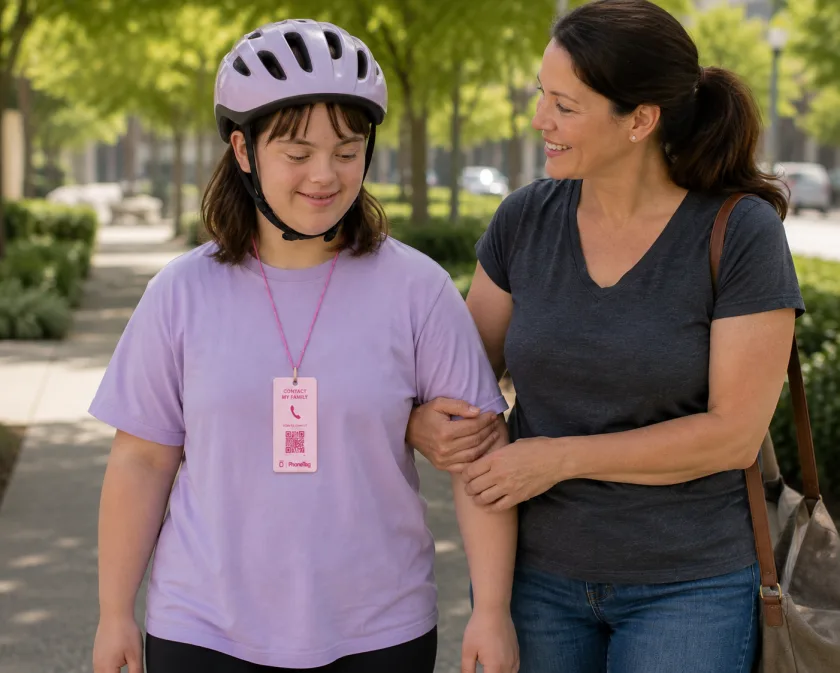
A scan-to-call tag replaces all five steps with one. The helper points a phone camera at the tag, taps once, and a private live video call opens in their browser. No app, no account, no dialing.
Now the situation looks completely different. You can see the person, their face, whether they are calm or distressed, and the street or the room around them. The scan's location is shared with you automatically, with one-tap directions. And most importantly, you can speak. You can talk to your child or your parent in the voice they know best, which for many non-speaking people is the fastest way to bring a situation down. You can tell the helper the things a bracelet could never fit: that she understands everything you say even though she will not answer, that he uses a device to talk and it is in the front pocket of the bag, that pointing at choices works and yes or no questions do not, that touching his shoulder will make this worse, that you are eight minutes away.
That is the actual product here. Not identification. Representation. Somebody who knows the person, present in the room, in seconds.
Where to put the tags
- The AAC (communication) or speech device case. A communication device left on a bus is expensive to replace and, far worse, it is that person's voice. A tag on the case turns a lost and found bin into a phone call.
- The wheelchair frame or walker, which does not get taken off and does not get left behind.
- The backpack, school bag, or day program bag.
- A belt loop, shoe, or the zipper pull of the jacket they always wear.
- A lanyard, if they will wear one comfortably, since it is the first place a helper looks.
One membership covers up to twelve tags on a single account, so you can cover every bag and every device rather than betting on one.
How it works alongside a communication card
Communication cards and wallet cards are genuinely good, especially for police interactions, because they explain in advance and in the person's own framing. Keep them. They also have a limit: they are static, so they can only answer the questions you predicted, and they cannot tell you that something is happening. The pairing that works is the card explaining the person, the medical ID carrying the medical facts for paramedics, and the tag opening the live line to someone who knows them. Different jobs, no overlap.
Being straight about the limits
PhoneTag needs the helper's phone to have a data connection, which is nearly always true and occasionally not. It is not a GPS tracker, so it tells you nothing until someone scans it. It is not a medical device and does not replace an engraved medical ID listing seizure disorders, allergies, or medications. And it depends on someone on your side being reachable, which is why up to ten people can ring on one account, and why the AI assistant can answer, take the details, and connect the call live when it reaches someone.
Give them a voice on the other end of the scan
Family Plan: 2 smart tags included, with video calling and the AI assistant. Ships same day, free US shipping. 30-day money-back guarantee.
Order nowCommon questions
What is the difference between non-verbal and non-speaking?
They describe the same situation. Many autistic adults prefer non-speaking, because non-verbal gets misread as meaning the person does not understand language, which is usually wrong. Minimally verbal is a related term: a small number of spoken words rather than none.
What is an AAC device?
AAC stands for augmentative and alternative communication. It covers anything used instead of or alongside speech, from a laminated picture board to a tablet app that speaks aloud when tapped. Because the device is effectively that person's voice, a contact tag on the case means whoever finds it can reach you in one scan.
What is the best ID tag for a non-verbal child?
One that does not require them to say, read, or confirm anything. A scan-to-call tag lets a helper reach a family member live, so somebody who knows the child can explain who they are and what they need.
How many autistic people are non-speaking?
Research commonly places non-speaking and minimally verbal people at roughly 25 to 30 percent of the autistic population. Speech differences also affect people with apraxia, cerebral palsy, aphasia, Down syndrome, and dementia.
Why not just print my phone number on a bracelet?
A printed number asks a stranger to find it, read it, dial it, get past your spam filter, and explain everything cold. A scan skips all of that and puts you in a live video call. A visible number and name also tells anyone reading it how to approach a vulnerable person.
Can I put a tag on an AAC or speech device?
Yes, and it is one of the best places for one. Whoever picks up a device left behind can reach you in a single scan instead of routing it through a lost and found.
Does the helper need an app or an account?
No. Any phone camera opens a call screen in the browser, with nothing to install. That matters when the helper is a bus driver, a nurse, or a police officer who will not download anything.
What is shown on the tag itself?
Nothing personal. No name, no number, no address, no diagnosis. The person scanning sees only the label you chose, such as "Contact my family," and your phone number is never revealed.
Can the call be text instead of video?
Yes. The person scanning can start with text, voice, or video, and you can answer in whichever mode fits the moment. A quiet text exchange is often the right choice inside a classroom or a hospital.