

Blog
Your kid lost their jacket again: what school lost and founds don't tell you
Somewhere in your kid's school right now, there is a bin, a bench, or a rolling cart with a hand-lettered "Lost and Found" sign taped to it, and it is already filling up. A few weeks into the school year is all it takes. If you have ever gone looking for a jacket in one of these piles, you already know the real problem is not that things get lost. It is that almost nothing in the bin ever finds its way home.
Why the bin fills up and stays full
Walk up to a school lost and found in October and you will see the same thing everywhere: rows of nearly identical navy jackets, a dozen matching water bottles from the same big-box store, lunchboxes in the same three patterns. To a teacher or an office aide, none of it has a name attached. Nothing about a plain fleece tells anyone which of the four kids who own an identical one it belongs to.
That is the entire problem in one sentence: an item without an identifier is not lost, it is anonymous. A jacket does not need to travel far to disappear. It falls off a hook, gets kicked under a cafeteria bench, or gets left on the playground after recess, and from that moment it is only a few feet from its owner and completely unreachable, because nothing on it says whose it is or how to reach them.
Schools do their best. Office staff sort what they can, PTA volunteers run periodic lost and found tables, and some schools email photos of unclaimed items home. But sorting takes time that nobody has much of, and a photo of forty identical hoodies does not help a parent who is not looking at their phone that day. Without a name or a tag, the system depends on someone remembering exactly what their kid wore that Tuesday, which almost never happens.
What actually gets an item back to its owner
The single biggest factor in whether a lost item gets returned is whether it says who it belongs to. That sounds obvious, and it is, which is exactly why it gets overlooked. Parents buy the jacket, wash it a few times, and only think about labeling it after it goes missing once. By then it is already one of the anonymous ones in the bin.
The fix is not complicated. It is making sure every jacket, backpack, lunchbox, and water bottle carries something that identifies it, before it ever gets lost. The only real question is where that identifier goes and what it reveals, because that decision changes who can act on it and what it exposes about your child.
The trade-off nobody explains at back-to-school night
A name written in permanent marker on the outside of a jacket solves the identification problem instantly. It also broadcasts your child's name to every adult and stranger who reads it, at drop-off, on the bus, at the park, for as long as the jacket is worn. Safety organizations have advised against this for years, not because any one instance is likely to be dangerous, but because a stranger who can greet a child by name no longer sounds like a stranger. We wrote a full guide on this trade-off in why you shouldn't put your child's name on their backpack, and the same logic applies to every jacket, lunchbox, and water bottle in the lost and found.
A phone number swaps one exposure for another. It skips the stranger-danger problem but puts your actual phone number on public display, readable by anyone who walks past a jacket hanging on a hook, permanently, for the life of the item.
The workable middle ground is an identifier that only means something to the person actively trying to return the item. Full names go inside, on a tag or an interior pocket, where the people checking lost and found already look. The outside gets something that a finder can act on without displaying anything personal, which is the gap a scan-to-call tag is built to close.
30-day money-back guarantee.
What changes when the tag can call you
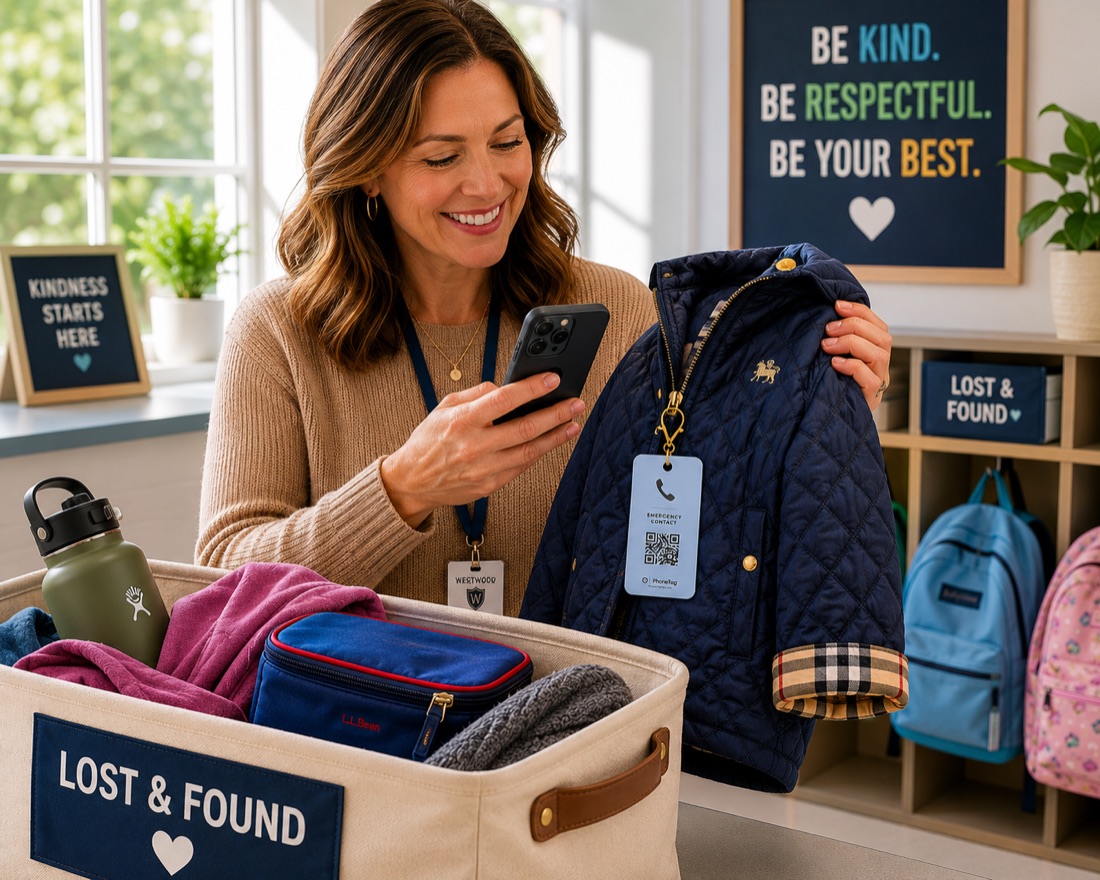
A PhoneTag is a small tag that clips onto a zipper pull or a backpack strap and carries a unique QR code. Whoever finds the jacket, a teacher, a bus driver, another parent, the kid at the next cubby, points their phone camera at it, and a private live video call to you opens right in their browser. There is no app for them to download and no account to create.
This is where a tag beats a bin. A jacket that falls off a hook at 10 a.m. does not need to wait for the Friday lost and found sweep. Whoever notices it can reach you before lunch. You see who found it and where, they hear where to leave it, and the jacket comes back the same afternoon instead of riding out the semester in a cart by the gym. If you cannot pick up, the finder can leave a voice or text message that reaches your phone right away, or you can turn on an optional AI receptionist that answers for you and sends you a summary.
None of this shows the finder your name, your phone number, or your address. The call is routed through PhoneTag, so a stranger who happens to find your kid's jacket learns nothing about your family beyond the fact that someone is on the other end of the call, ready to say thank you.
What a tag cannot do
It is worth being honest about the limits. A tag only helps if it is still attached when the jacket is found, so it works best clipped somewhere secure rather than pinned loosely. It does not replace teaching kids to check for their own things before they leave a room, and it will not make a school run its lost and found any faster on its own. What it does is remove the single biggest point of failure, the fact that most lost items carry no way to reach the owner at all. Pair it with the habits you already have, like a quick look around before the bus leaves, and far fewer jackets end up anonymous in the first place.
Tag it before it disappears
Family Plan: $59 a year, 2 smart tags included. Video calling and the AI assistant included. Extra tags $12. 30-day money-back guarantee.
Learn moreCommon questions
Why do school lost and found bins get so full?
Most items go in unlabeled, and a classroom full of the same jackets and water bottles from the same few stores looks identical once it lands in a bin. Staff have no fast way to match an item to a name, so it sits until the school sets aside time for a bulk return, which is usually not often.
Does labeling gear actually help?
Yes, a name or a scannable tag is the single biggest factor in whether an item gets back to its owner. The problem is not whether to label, it is where. A name on the outside identifies the item to everyone, which safety groups advise against, while a name or tag on the inside or on a discreet tag only needs to be found by the one person checking.
What should I do instead of writing my child's name on the outside of their jacket?
Put the full name inside, on a tag, collar, or pocket, where staff already check. For the outside, use initials, a symbol, or a small scannable tag that lets a finder reach you without displaying your child's name or your phone number.
How is a PhoneTag different from just writing a phone number on the jacket?
A phone number on a jacket is public to anyone who reads it, permanently. A PhoneTag carries a QR code instead. Whoever finds the jacket scans it and a private video call opens in their browser, so they can reach you without ever seeing your number, and the tag works whether the finder is a teacher, a bus driver, or another parent.
What if the item is found after school hours or over a weekend?
The tag does not depend on the school office being open. Anyone who finds the jacket can scan it and reach you directly, any time. If you cannot pick up, they can leave a voice or text message, or an optional AI receptionist can take the message for you.